
DISCLAIMER: This is general nutritional information. Consult your healthcare provider for personalized dietary advice, especially if you have cardiovascular disease, cholesterol issues, or specific medical conditions.
You know what fats are and why you need them. Now let’s talk about the practical stuff: which foods pack the highest-quality fats, which ones to avoid like the plague, and which myths you can safely ignore.
The short version: Not all fats are created equal. Salmon fat and donut fat both contain 9 calories per gram—but your body treats them like a Ferrari treats premium gas versus diesel fuel.
Let’s rank the fat sources, optimize your omega balance, and settle the biggest fat debates once and for all.
Best Fat Sources: The Quality Hierarchy
Not all fats are created equal. Fat quality depends on the fatty acid profile, oxidative stability (does it go rancid easily?), nutrient density, and how it affects inflammation.
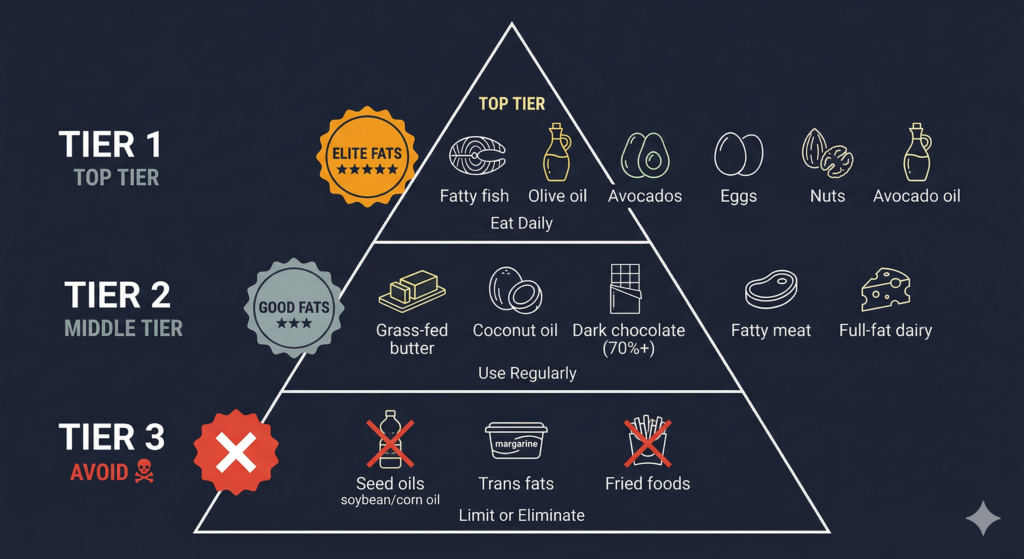
Here’s the tier system from superfood to straight garbage.
Tier 1: Elite Fat Sources (Eat These Daily)
These are your nutritional MVPs—loaded with beneficial fats, minimal downsides, and scientifically proven health benefits.
Fatty Fish (The Omega-3 Kings)
Salmon, mackerel, sardines, herring, anchovies—these are the undisputed champions of the fat world.
Why they dominate:
- Packed with EPA and DHA omega-3s (the forms your body uses directly)
- High-quality complete protein (20-25g per 100g)
- Rich in vitamin D, selenium, B vitamins
- Anti-inflammatory, brain-boosting, heart-protective
Omega-3 content per 3oz (85g) serving:
- Atlantic mackerel: 1.1g
- Wild salmon: 1.5g
- Sardines (canned): 1.3g
- Herring: 1.4g
- Rainbow trout: 1.0g
The catch: Farm-raised salmon has lower omega-3s and higher omega-6s than wild-caught. Choose wild when possible, but farm-raised still beats no fish at all.
Target: 2-3 servings per week minimum. If you can afford it, eat fatty fish 4-5x per week.
The mercury concern: Smaller fish (sardines, anchovies, mackerel) have less mercury than larger fish (tuna, swordfish). Pregnant women should limit tuna but can eat smaller fish freely.
Extra Virgin Olive Oil (The Mediterranean Miracle)
The most studied and validated fat on the planet. Olive oil is the backbone of the Mediterranean diet—consistently ranked as the healthiest eating pattern for longevity.
Why it’s elite:
- 73% monounsaturated fat (oleic acid)
- Rich in polyphenols (antioxidants)
- Anti-inflammatory
- Improves cholesterol ratios (lowers LDL, raises HDL)
- Linked to reduced heart disease, stroke, and Alzheimer’s
Quality matters: “Extra virgin” means cold-pressed, unrefined, and higher in polyphenols. Regular “olive oil” is often refined and stripped of benefits.
How to use it:
- Drizzle on salads, vegetables, finished dishes
- Low-medium heat cooking (not high heat—smoke point is 375°F)
- 1-3 tablespoons daily
Pro tip: Look for dark glass bottles (light degrades polyphenols) and check for a harvest date (fresher = better).
Avocados (The Creamy Powerhouse)
Nature’s butter. Avocados are 77% fat by calorie, mostly monounsaturated.
Nutritional profile (1 medium avocado):
- 21g fat (15g monounsaturated)
- 9g fiber
- 320mg potassium (more than a banana)
- Vitamins E, K, C, B5, B6, folate
Why they’re great:
- Extremely satiating (keeps you full for hours)
- Rich in fiber (supports gut health and blood sugar control)
- Helps absorb fat-soluble vitamins from other foods
- Anti-inflammatory
How to use:
- Sliced on toast or salads
- Blended into smoothies (makes them creamy)
- Guacamole with vegetables
- Half an avocado per day is a solid baseline
The only downside: Calorie-dense. One avocado = 240 calories. Easy to overeat if you’re tracking calories for fat loss.
Nuts and Seeds (The Snackable Superstars)
Nutrient-dense, portable, and loaded with healthy fats, protein, and micronutrients.
The best options:
Almonds (1 oz / 28g):
- 14g fat (9g monounsaturated)
- 6g protein
- 3.5g fiber
- High in vitamin E, magnesium
Walnuts (1 oz):
- 18g fat (2.5g omega-3 ALA)
- 4g protein
- Best nut source of omega-3s
Chia seeds (1 tbsp):
- 2.5g omega-3 ALA
- 5g fiber
- Complete protein (rare for plant foods)
Flaxseeds (1 tbsp, ground):
- 2.3g omega-3 ALA
- 2g fiber
- Must be ground (whole seeds pass through undigested)
Hemp seeds (1 tbsp):
- 3g fat (balanced omega-3 to omega-6 ratio)
- 3g protein
Macadamia nuts (1 oz):
- 21g fat (17g monounsaturated—highest of any nut)
- Buttery, rich flavor
Brazil nuts (1 oz):
- High in selenium (200% daily value in just 2 nuts)
- Limit to 2-3 nuts per day (too much selenium is toxic)
How to use:
- Raw or dry-roasted (avoid oils and added sugar)
- Nut butters (almond, cashew, peanut—natural, no added oils)
- Ground flaxseeds or chia seeds in smoothies, oatmeal, yogurt
- 1-2 oz (small handful) per day
Warning: Nuts are calorie bombs. A handful is 150-200 calories. Easy to mindlessly eat 500+ calories if you’re not paying attention.
Whole Eggs (The Perfect Package)
For decades, eggs were demonized for their cholesterol content. Now we know dietary cholesterol has minimal impact on blood cholesterol for most people.
Why eggs are elite:
- One of the most nutrient-dense foods on the planet
- Complete protein (6g per egg)
- Healthy fats (5g per egg, mostly monounsaturated)
- Choline (brain health, liver function)
- Vitamins A, D, E, K, B12
- Lutein and zeaxanthin (eye health)
The yolk vs white debate: The yolk contains all the fat, vitamins, and most nutrients. Egg whites are just protein. Eating whole eggs is superior unless you’re on an extreme fat restriction.
Cholesterol concern debunked: Most people can eat 1-3 eggs daily without affecting blood cholesterol. A small percentage (hyper-responders) may see LDL rise slightly, but HDL usually rises more, improving overall cholesterol ratios.
How to use:
- Scrambled, fried, boiled, poached
- Added to smoothies (raw—Rocky style)
- Baked into dishes
- 1-3 whole eggs per day for most people
Quality upgrade: Pasture-raised eggs have higher omega-3s and better nutrient profiles than conventional eggs. Worth the extra cost if you can afford it.
Avocado Oil (The High-Heat Champion)
Similar fatty acid profile to olive oil (70% monounsaturated) but with a much higher smoke point.
Why it’s great:
- Smoke point of 520°F (perfect for high-heat cooking, searing, stir-frying)
- Neutral flavor (doesn’t overpower dishes like olive oil can)
- Rich in lutein (eye health)
- Stable (doesn’t oxidize easily)
How to use:
- High-heat cooking (searing meat, stir-frying, roasting at 400°F+)
- Salad dressings (if you prefer neutral flavor over olive oil)
- 1-2 tablespoons for cooking
The downside: More expensive than olive oil. Save it for high-heat applications where olive oil would burn.
Tier 2: Good Fats (Use Regularly, But Not Your Only Sources)
These are solid choices with some benefits, but they don’t quite reach elite status due to limitations or concerns.
Grass-Fed Butter and Ghee
Real butter from grass-fed cows contains beneficial nutrients that conventional butter lacks.
Why it’s good:
- Contains conjugated linoleic acid (CLA)—a natural trans fat with potential fat-loss benefits
- Rich in vitamins A, D, E, K2
- Butyrate (a short-chain fatty acid that supports gut health)
- Delicious (let’s be honest, this matters)
Grass-fed vs conventional: Grass-fed butter has 5x more CLA and better omega-3 to omega-6 ratio. The difference is significant.
Ghee (clarified butter): Butter with milk solids removed. Lactose-free, higher smoke point (485°F), shelf-stable. Great for people with dairy sensitivity.
Saturated fat content: Butter is 63% saturated fat. Moderate intake (1-2 tablespoons daily) is fine for most people, but if you have high LDL cholesterol or heart disease, consult your doctor.
How to use:
- Cooking eggs, vegetables, meat
- Spreading on toast (obviously)
- Adding to coffee (bulletproof coffee—though this is overrated unless you’re doing keto)
- 1-2 tablespoons daily max
Coconut Oil (The Controversial One)
Coconut oil is 82% saturated fat, mostly medium-chain triglycerides (MCTs).
The pros:
- MCTs are metabolized differently than long-chain fats (go straight to the liver for quick energy)
- High smoke point (350°F refined, 280°F virgin)
- Antimicrobial properties (lauric acid)
- Stable (doesn’t go rancid easily)
The cons:
- Raises LDL cholesterol in some people (though it also raises HDL)
- No omega-3s
- Hyped beyond what the science supports (not a miracle fat)
The verdict: Coconut oil is fine in moderation (1-2 tablespoons daily), but it shouldn’t replace olive oil or avocado oil as your primary fat. Use it occasionally for flavor or high-heat cooking.
Virgin vs refined: Virgin (cold-pressed) has a coconut flavor and more nutrients. Refined is neutral-flavored and more processed.
Dark Chocolate (70%+ Cacao)
Yes, dark chocolate contains fat—about 12g per ounce, mostly saturated (from cocoa butter) and monounsaturated.
Why it’s good:
- Rich in flavonoids (antioxidants)
- Improves blood flow and heart health
- Mood-boosting (contains theobromine and small amounts of caffeine)
- Satisfies sweet cravings without being pure sugar
The catch: Still calorie-dense (150-170 calories per ounce). Easy to overeat.
Quality matters: Choose 70%+ cacao with minimal added sugar. Milk chocolate doesn’t count (too much sugar, too little cacao).
How to use:
- 1-2 squares (about 0.5-1 oz) as a daily treat
- Melted into smoothies or oatmeal
- Pairs well with nuts or fruit
Fatty Cuts of Meat (Beef, Pork, Lamb)
Red meat gets a bad rap, but the truth is nuanced.
Why it can be good:
- Complete protein with all essential amino acids
- Rich in iron, zinc, B12, creatine
- Satisfying and nutrient-dense
- Grass-fed beef has better omega-3 to omega-6 ratio than grain-fed
Why it can be problematic:
- High in saturated fat (varies by cut)
- Grain-fed beef has poor omega-6 to omega-3 ratio
- Processed red meat (bacon, sausage, deli meats) linked to health issues
- Environmental concerns
The smart approach:
- Choose grass-fed/pasture-raised when possible
- Limit to 2-3 servings per week
- Balance with fish, poultry, and plant proteins
- Avoid processed meats (bacon, sausage, hot dogs) as daily staples
Best cuts for fat balance:
- Ribeye (marbled, fatty)
- Ground beef (80/20 or 85/15)
- Lamb chops
- Pork belly (in moderation)
Leaner options if limiting saturated fat:
- Sirloin
- Tenderloin
- 90/10 or 93/7 ground beef
Full-Fat Dairy (Yogurt, Cheese, Milk)
The fat in dairy is mostly saturated, but full-fat dairy has some benefits that low-fat versions lack.
Why full-fat is better than low-fat:
- More satiating (keeps you full longer)
- Contains fat-soluble vitamins (A, D, E, K)
- Some studies link full-fat dairy to lower obesity risk (possibly because people eat less overall when satisfied)
- Tastes way better (low-fat dairy often has added sugar to compensate for flavor loss)
Best choices:
- Greek yogurt (high protein, probiotics)
- Cottage cheese (high protein, low calorie)
- Hard cheeses (cheddar, parmesan, gouda—nutrient-dense)
- Kefir (fermented, probiotic-rich)
The catch: Calorie-dense. Cheese is easy to overeat.
Lactose intolerance: Hard cheeses and Greek yogurt are lower in lactose. Kefir’s probiotics help digest lactose.
How much: 1-2 servings daily (e.g., 1 cup Greek yogurt, 1 oz cheese).
Tier 3: Fats to Limit or Avoid
These fats are either nutritionally inferior, pro-inflammatory, or outright harmful.
Seed and Vegetable Oils (The Inflammation Bombs)
Soybean oil, corn oil, sunflower oil, safflower oil, canola oil, cottonseed oil.
Why they’re problematic:
- Extremely high in omega-6 fatty acids (linoleic acid)
- Highly processed (extracted using heat and chemical solvents)
- Prone to oxidation (especially when heated)
- Dominate the modern food supply (restaurant food, packaged snacks, salad dressings)
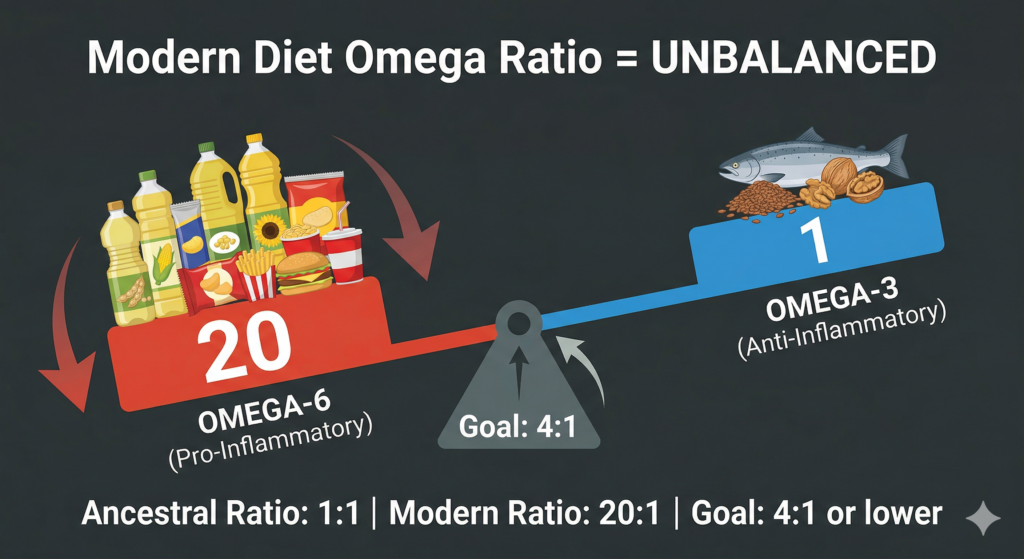
The omega-6 overload: These oils are the primary driver of the modern 20:1 omega-6 to omega-3 ratio (should be 4:1 or lower). Chronic inflammation results.
The oxidation problem: When these oils are heated (deep-frying, high-heat cooking), they form harmful oxidized lipids and aldehydes linked to heart disease and cancer.
What about canola oil? Canola is better than soybean or corn oil (more monounsaturated, less omega-6), but it’s still highly processed. Olive oil or avocado oil are superior.
The practical challenge: These oils are in everything—restaurant food, packaged snacks, baked goods, salad dressings. You can’t avoid them 100%, but you can minimize.
How to minimize:
- Cook at home with olive oil, avocado oil, butter, or ghee
- Avoid deep-fried restaurant food
- Read labels—if you see “soybean oil” or “vegetable oil,” skip it
- Make your own salad dressings (olive oil + vinegar/lemon)
Trans Fats (The Banned Villain)
Partially hydrogenated oils—artificially created trans fats.
Why they’re evil:
- Raise LDL (bad cholesterol)
- Lower HDL (good cholesterol)
- Increase inflammation
- Significantly increase heart disease risk
Where they used to hide:
- Margarine (old formulas)
- Shortening
- Packaged baked goods
- Fried fast food
- Microwave popcorn
The good news: The FDA banned artificial trans fats in 2018. They’ve mostly disappeared from the food supply.
Natural trans fats: Small amounts occur naturally in dairy and beef (CLA). These are not harmful and may have benefits.
How to avoid: Read labels. If you see “partially hydrogenated oil,” don’t buy it.
Rancid or Oxidized Fats
Any fat can become harmful if it goes rancid (oxidized).
Signs of rancidity:
- Off smell (fishy, paint-like, sour)
- Bitter or stale taste
- Change in color
Fats most prone to oxidation:
- Polyunsaturated fats (fish oil, flaxseed oil, walnut oil)
- Oils stored in clear bottles exposed to light
- Oils stored at warm temperatures
- Fried oils reused multiple times
How to prevent:
- Store oils in dark bottles in cool, dark places
- Refrigerate flaxseed oil, walnut oil, and fish oil after opening
- Don’t reuse frying oil
- Buy smaller bottles (use within 2-3 months)
The Omega-3 vs Omega-6 Battle (The Inflammation Seesaw)
This is one of the most important—and most ignored—concepts in modern nutrition.
The ancestors’ ratio: 1:1 omega-6 to omega-3 (balanced)
The modern ratio: 20:1 or worse (pro-inflammatory disaster)
Think of omega-6 and omega-3 as two kids on a seesaw. When balanced, everything’s fine. When one side gets too heavy (omega-6), the whole system tips into chaos.
Omega-6 fatty acids (linoleic acid):
- Essential (you need some)
- Precursors to pro-inflammatory molecules (when excessive)
- Found in: Vegetable oils, processed foods, grain-fed meat
Omega-3 fatty acids (EPA, DHA, ALA):
- Essential (you need these too)
- Precursors to anti-inflammatory molecules
- Found in: Fatty fish, flaxseeds, chia seeds, walnuts, algae
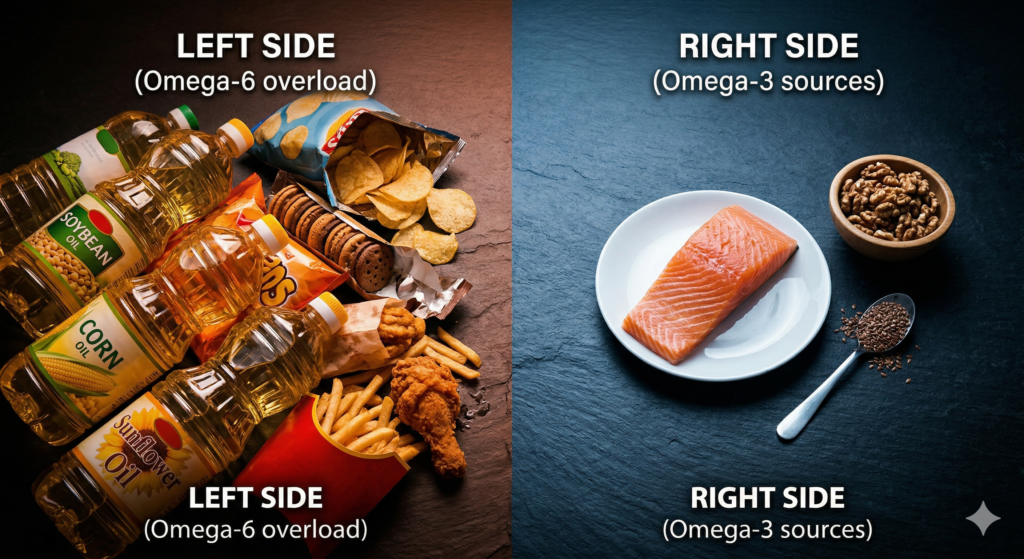
The problem: Modern diets are drowning in omega-6 from vegetable oils and processed foods, while omega-3 intake has plummeted (we eat way less fish than our ancestors).
The result: Chronic low-grade inflammation—the root cause of heart disease, diabetes, arthritis, Alzheimer’s, autoimmune diseases, and obesity.
The fix:
Reduce omega-6:
- Stop cooking with soybean, corn, sunflower, and safflower oil
- Minimize packaged snacks and restaurant food
- Choose grass-fed meat (better ratio) over grain-fed
Increase omega-3:
- Eat fatty fish 2-3x per week
- Add ground flaxseeds or chia seeds to meals daily (1-2 tablespoons)
- Snack on walnuts
- Consider an omega-3 supplement (fish oil or algae oil)
Target ratio: Aim for 4:1 or lower (omega-6 to omega-3).
How to measure: You can test your omega-3 index with an at-home blood test (OmegaQuant). Target: 8% or higher (most Americans are below 4%).
What Happens If You Don’t Eat Enough Fat?
Your body doesn’t store essential fatty acids like it stores other nutrients. You need a consistent supply.
Short-term effects (weeks of low fat):
Constant hunger:
- Fat is satiating—without it, you’re always hungry
- You end up eating more calories from carbs to feel satisfied
- Makes fat loss much harder
Dry skin and hair:
- Cell membranes need fat to stay flexible
- Skin becomes flaky, hair becomes brittle
- Lips crack, elbows and knees get rough
Poor workout recovery:
- Joints ache (less lubrication and cushioning)
- Inflammation increases
- Tendons and ligaments weaken
Energy crashes:
- Without fat for sustained energy, you rely on carbs
- Blood sugar spikes and crashes throughout the day
- The 3 PM slump gets brutal
Long-term effects (months of very low fat):
Hormonal disaster:
- Testosterone drops 10-15% (men and women)
- Estrogen and progesterone crash (women)
- Missing or irregular periods (women)
- Low libido, fatigue, depression
Brain fog:
- Your brain needs DHA to function
- Memory problems, poor focus, slow processing
- Increased risk of depression and anxiety
Vitamin deficiencies:
- Can’t absorb vitamins A, D, E, K without fat
- Vision problems (vitamin A)
- Weak bones (vitamin D)
- Poor immune function (vitamin A, D, E)
Weakened immune system:
- Cell membranes become rigid
- Immune cells can’t function properly
- Get sick more often, recover slower
Increased injury risk:
- Tendons and ligaments weaken
- Joints lose cushioning
- More sprains, strains, and chronic pain
Real-world example: Female athletes who drop body fat below 15% often lose their periods (amenorrhea). Their bodies shut down reproduction because there’s not enough fat to support a pregnancy. Bone density drops. Stress fractures increase. Hormones crash. All because fat intake is too low.
The minimum: Never go below 20% of calories from fat unless medically supervised. 25-30% is safer for most people.
Can You Eat Too Much Fat?
For healthy people eating whole foods, it’s hard to eat “too much” fat in a harmful way. But there are scenarios where excessive fat backfires.
Scenario 1: Eating too many calories (regardless of source)
Fat has 9 calories per gram. It’s energy-dense. Easy to overeat.
Example:
- 2 tablespoons of olive oil = 240 calories
- 1 avocado = 240 calories
- 2 oz almonds = 320 calories
- Total: 800 calories from fat alone (before you’ve eaten any protein or carbs)
If you’re trying to lose fat, eating unlimited amounts of “healthy fats” will still make you gain weight if you exceed your calorie needs.
The fix: Track portions, especially when eating calorie-dense fats like nuts, nut butters, oils, and avocados.
Scenario 2: Keto extremes (80%+ fat)
Very high-fat diets (ketogenic diets at 70-80% fat) work for some people but can cause issues for others.
Potential problems:
- Digestive distress (diarrhea, nausea from too much fat)
- Nutrient deficiencies (hard to get enough vegetables and fiber)
- Poor athletic performance (if you do high-intensity training)
- Elevated LDL cholesterol in some people (not everyone, but some hyper-responders)
- Social isolation (very restrictive, hard to eat out)
Who keto works for:
- People with epilepsy (original medical use)
- Some people with insulin resistance or type 2 diabetes
- People who naturally prefer fatty foods and low hunger
- People doing low-intensity activity (walking, light cardio)
Who keto doesn’t work for:
- High-intensity athletes (sprinters, CrossFit, heavy lifters)
- People with a history of eating disorders
- People who love carbs and can’t sustain restriction
- People with certain genetic variants affecting fat metabolism
The verdict: Keto can work, but it’s not superior to moderate-carb diets for fat loss when calories and protein are matched. Choose the approach you can sustain.
Scenario 3: Wrong types of fat (omega-6 overload)
You can eat a high-fat diet and still be unhealthy if most of your fat comes from seed oils and processed foods.
Example of a high-fat but unhealthy diet:
- Fried chicken (soybean oil)
- French fries (vegetable oil)
- Packaged cookies (palm oil, shortening)
- Salad dressing (soybean oil)
- Total: 60% fat, but terrible quality
Even though fat intake is high, the omega-6 overload drives inflammation.
The fix: Prioritize quality fats (olive oil, fish, avocados, nuts) over processed fats (seed oils, fried foods).
Scenario 4: Ignoring other macros
Some people go so high-fat that they under-eat protein or vegetables.
Example:
- 70% fat, 20% carbs, 10% protein = not enough protein for muscle maintenance
- Eating only fatty meat and cheese = missing vegetables, fiber, micronutrients
The fix: Balance all three macros. Protein, carbs, and fat all have important roles. Don’t neglect any of them.
The upper limit for fat:
For most people: 35-40% of calories from fat is the practical upper limit for long-term health.
Beyond 50% fat: You’re in specialized diet territory (keto, carnivore). Not inherently bad, but requires planning and isn’t necessary for most people.
Fat Myths Debunked
Myth 1: “Eating fat makes you fat”
Reality: Eating excess calories makes you fat—whether from fat, protein, or carbs. Fat is calorie-dense (9 cal/g), so it’s easier to overconsume, but dietary fat itself doesn’t automatically become body fat.
The science: Controlled studies show people lose equal amounts of fat on high-fat vs low-fat diets when calories and protein are matched. Total calorie intake matters more than fat percentage.
Myth 2: “Saturated fat causes heart disease”
Reality: It’s complicated. The relationship between saturated fat and heart disease is weaker than previously thought and depends heavily on what you replace saturated fat with.
The nuance:
- Replacing saturated fat with sugar or refined carbs = bad for heart health
- Replacing saturated fat with unsaturated fats (olive oil, fish) = good for heart health
- Saturated fat in the context of a whole-foods diet (grass-fed meat, full-fat dairy) appears neutral or even beneficial for some people
Recent meta-analyses show weak or no association between saturated fat intake and heart disease when total calories are controlled. Individual response varies—some people’s cholesterol spikes, others don’t.
The takeaway: Moderate saturated fat (10-15% of calories) from whole foods is fine for most people. But replacing some saturated fat with monounsaturated or omega-3 fats is probably beneficial.
Myth 3: “All vegetable oils are healthy”
Reality: “Vegetable oil” sounds healthy, but most are highly processed seed oils loaded with omega-6 fatty acids.
The problem oils: Soybean, corn, sunflower, safflower, cottonseed oil.
The better options: Olive oil, avocado oil (not technically “vegetable oils” but plant-based).
The marketing trick: Food companies slap “vegetable oil” on labels to make it sound wholesome. In reality, these oils are extracted using heat and chemical solvents, then bleached and deodorized.
Myth 4: “Low-fat diets are best for fat loss”
Reality: Low-fat diets can work, but they’re not superior to moderate-fat or high-fat diets for fat loss when calories are equal.
The research: Dozens of studies comparing low-fat vs low-carb diets show similar fat loss when calories and protein are matched. The best diet is the one you can stick to.
Why low-fat diets often fail:
- Less satiating (constant hunger)
- Hormonal disruption (testosterone, estrogen drop)
- Poor adherence (people can’t sustain it)
The sweet spot: 25-35% fat for most people balances satiety, hormones, and sustainability.
Myth 5: “Eating fat before bed makes you fat”
Reality: Meal timing has minimal impact on fat gain. Total daily calories matter most.
The science: Your body doesn’t suddenly store fat differently at night. Fat is absorbed slowly over several hours regardless of when you eat it.
The one caveat: Eating a huge high-fat meal right before bed might disrupt sleep quality (digestion can interfere with deep sleep). But it won’t make you fatter than eating the same meal earlier.
Myth 6: “Cholesterol in food raises your blood cholesterol”
Reality: For most people (about 75%), dietary cholesterol has minimal impact on blood cholesterol. Your liver produces most of your cholesterol and adjusts production based on intake.
The hyper-responders: About 25% of people are “hyper-responders” whose blood cholesterol does rise with dietary cholesterol. If you’re in this group, limit egg yolks and shellfish.
The science: The 2015 Dietary Guidelines removed the 300mg cholesterol limit after decades of research showed dietary cholesterol isn’t the villain it was thought to be.
For most people: Eggs, shellfish, and full-fat dairy are perfectly fine.
Myth 7: “You need to eat fat to burn body fat”
Reality: Your body burns body fat when you’re in a calorie deficit—regardless of dietary fat intake.
The keto claim: “Eating fat puts you in fat-burning mode.” Not quite. Ketosis means you’re burning dietary fat and body fat for fuel, but you still need a calorie deficit to lose body fat.
The truth: You can lose body fat on a high-carb, low-fat diet just as effectively as a high-fat, low-carb diet if calories are equal.
Fat for Special Populations
Athletes and Endurance Training
Endurance athletes (marathoners, cyclists, ultra-runners) can benefit from higher fat intake because their bodies become “fat-adapted”—better at burning fat for fuel during long, low-intensity efforts.
Fat adaptation benefits:
- Spare glycogen stores (use fat first, save carbs for later)
- Go longer without “bonking” (hitting the wall)
- Less reliance on frequent fueling during races
Fat needs for endurance athletes:
- 25-35% of calories from fat (not keto, but moderate)
- Focus on omega-3s (reduce inflammation from high training volume)
- Timing: Fat is fine pre-workout for long, easy sessions but not ideal pre-competition
What doesn’t work for athletes:
- Very high-fat diets (70%+) impair high-intensity performance
- Sprinters, CrossFitters, and team-sport athletes perform worse on keto
- You can’t fuel max-effort bursts with fat—you need carbs
Women and Hormonal Health
Women need more body fat than men for hormonal health and reproductive function.
Minimum body fat for menstruation:
- 15-18% body fat minimum (some women need 20%+)
- Below this, periods stop (hypothalamic amenorrhea)
- Bone density drops, stress fractures increase
Dietary fat requirements:
- At least 25-30% of calories from fat
- Prioritize omega-3s (reduce period cramps and inflammation)
- Don’t fear saturated fat (needed for hormone production)
Special considerations:
- Pregnant/breastfeeding women: Need extra fat (especially DHA for baby’s brain development)
- Aim for 200-300mg DHA daily (fatty fish 2-3x per week or algae supplement)
Vegans and Vegetarians
Plant-based eaters can get healthy fats, but it requires intentionality.
Challenges:
- No EPA/DHA from fish (plant omega-3s are ALA, which converts poorly to EPA/DHA—only 5-10% efficiency)
- Easy to over-rely on omega-6-rich nuts and seeds
Solutions:
- Algae-based DHA supplements (200-300mg daily)
- Flaxseeds and chia seeds (high ALA, grind fresh for best absorption)
- Walnuts (best nut source of omega-3)
- Minimize cooking with omega-6 seed oils
- Use olive oil and avocado oil instead
Sample vegan fat sources:
- 1 tbsp ground flaxseeds (2.3g ALA)
- 1 oz walnuts (2.5g ALA)
- Half avocado (15g fat)
- 2 tbsp almond butter (16g fat)
- Total: Good monounsaturated and ALA intake, but still need DHA supplement
Older Adults (50+ years)
As you age, fat needs shift slightly.
Benefits of adequate fat:
- Supports brain health (reduce dementia risk)
- Maintains hormone production (testosterone, estrogen decline with age)
- Prevents dry skin and joint pain
- Improves absorption of fat-soluble vitamins
Recommendations:
- Keep fat at 25-35% of calories
- Prioritize omega-3s (2-3g EPA+DHA daily for brain protection)
- Don’t fear egg yolks or full-fat dairy (unless doctor advises otherwise)
- Cook with olive oil (heart-protective)
Special note: Some older adults on cholesterol medications (statins) may need to monitor saturated fat intake more carefully. Work with your doctor.
Frequently Asked Questions About Fat Sources
What are the best sources of omega-3 fats?
The best sources of EPA and DHA (the forms your body uses) are fatty fish: salmon, mackerel, sardines, herring, and anchovies. Aim for 2-3 servings per week. Plant sources (flaxseeds, chia seeds, walnuts) provide ALA, which converts poorly to EPA/DHA (5-10% efficiency). If you don’t eat fish, take an algae-based omega-3 supplement.
Should I avoid all vegetable oils?
Not all vegetable oils are bad. Olive oil and avocado oil are excellent. Avoid highly processed seed oils (soybean, corn, sunflower, safflower) which are high in omega-6 and prone to oxidation. Use olive oil for low-medium heat, avocado oil for high heat, and avoid deep-frying with any oil repeatedly.
Is coconut oil healthy?
Coconut oil is 82% saturated fat, mostly medium-chain triglycerides (MCTs). It’s not harmful in moderation (1-2 tablespoons daily), but it’s not a miracle food either. It raises LDL cholesterol in some people. Use it occasionally for flavor or high-heat cooking, but don’t replace olive oil as your primary fat source.
How much fat should I eat for fat loss?
For fat loss, aim for 25-30% of total calories from fat. This preserves hormones, maintains satiety, and supports vitamin absorption. Don’t go below 20% fat even in a deficit—hormones will crash and adherence will suffer. Focus on a calorie deficit from all macros, not just slashing fat.
Can I eat unlimited healthy fats and still lose weight?
No. Even healthy fats contain 9 calories per gram. Eating unlimited amounts of olive oil, avocados, nuts, and fatty fish will cause weight gain if you exceed your calorie needs. Portion control matters. Track servings: 1-2 tbsp oils, half an avocado, 1-2 oz nuts per day.
Do I need omega-3 supplements if I eat fish?
If you eat fatty fish (salmon, mackerel, sardines) 2-3 times per week, you probably don’t need supplements. If you eat fish less often or not at all, consider fish oil or algae oil providing 1-3g EPA+DHA daily. Choose third-party tested brands (IFOS, USP) to ensure purity.
Is butter better than margarine?
Yes. Butter is a natural fat from cream. Margarine is made from processed vegetable oils, and old formulas contained trans fats. Modern margarine is trans-fat-free but still highly processed. Choose grass-fed butter for better nutrient profile (more CLA, omega-3s, vitamins). Use in moderation (1-2 tablespoons daily).
Should I eat egg yolks or just egg whites?
Eat the whole egg. The yolk contains all the fat, fat-soluble vitamins (A, D, E, K), choline, and most nutrients. Egg whites are just protein. For most people, dietary cholesterol in eggs doesn’t significantly raise blood cholesterol. Unless you’re a hyper-responder or your doctor advises otherwise, whole eggs are superior.
The Bottom Line: Quality Over Quantity
Fat isn’t the enemy. It never was. The low-fat movement failed because it ignored biology.
Your body needs fat to make hormones, fuel your brain, absorb vitamins, build cell membranes, and regulate inflammation.
The simple strategy:
- Cook with olive oil (low-medium heat) or avocado oil (high heat)
- Eat fatty fish 2-3 times per week (salmon, mackerel, sardines)
- Include nuts, seeds, and avocados regularly
- Don’t fear butter, eggs, or fatty meat in moderation
- Avoid seed oils (soybean, corn, sunflower, safflower)
- Balance your omega-6 to omega-3 ratio (aim for 4:1 or lower)
- Hit 25-35% of your daily calories from fat
Fat quality matters more than fat quantity.
500 calories of salmon fat and 500 calories of deep-fried donut fat are not the same. One reduces inflammation, supports your brain, and protects your heart. The other drives inflammation, oxidative stress, and disease.
Choose your fats wisely. Your body will thank you.
Scientific References & Further Reading
This article is based on peer-reviewed research and expert consensus:
Dietary Fats & Health:
- Harvard T.H. Chan School of Public Health – Fats and Cholesterol (https://www.hsph.harvard.edu/nutritionsource/what-should-you-eat/fats-and-cholesterol/)
- American Heart Association – Dietary Fats (https://www.heart.org/en/healthy-living/healthy-eating/eat-smart/fats/dietary-fats)
- National Institutes of Health – Omega-3 Fatty Acids (https://ods.od.nih.gov/factsheets/Omega3FattyAcids-HealthProfessional/)
Fat Quality & Inflammation:
- Mayo Clinic – Dietary Fat: Know Which to Choose (https://www.mayoclinic.org/healthy-lifestyle/nutrition-and-healthy-eating/in-depth/fat/art-20045550)
- National Institutes of Health – Omega-6 Fatty Acids (https://www.ncbi.nlm.nih.gov/pmc/articles/PMC3335257/)
Saturated Fat Research:
- American Journal of Clinical Nutrition – Meta-Analysis of Saturated Fat and Heart Disease (https://academic.oup.com/ajcn/article/91/3/535/4597110)
Note: Always consult your healthcare provider for personalized medical advice.
Continue Your Nutrition Education
The Complete Macronutrient Series:
- What Are Calories? Energy & Metabolism Explained (https://enduresquad.com/what-are-calories/)
- What Is Insulin & How to Control Blood Sugar (https://enduresquad.com/what-is-insulin-how-to-control-blood-sugar/)
- Understanding Carbohydrates: Your Body’s Fuel (https://enduresquad.com/what-are-carbohydrates-your-bodys-fuel-explained-why-athletes-drink-sugar-water/)
- What Is Protein? Part 1: Why Your Body Needs It (https://enduresquad.com/what-is-protein-part-1/)
- What Is Protein? Part 2: Best Sources & Timing (https://enduresquad.com/what-is-protein-part-2/)
- What Are Fats? Part 1: The Misunderstood Macronutrient (https://enduresquad.com/what-are-fats-part-1/)
Tools & Calculators:
- BMR Calculator – Find Your Baseline (https://enduresquad.com/bmr-for-all/)
- Ideal Weight Calculator (https://enduresquad.com/ideal-weight-calculator/)
- Heart Rate Zones Calculator (https://enduresquad.com/heart_rate_calculator/)
Ready to Optimize Your Nutrition?
Get a personalized plan tailored to YOUR goals, body, and lifestyle:
- Custom Nutrition Plans (https://enduresquad.com/custom-plans/)
- Fat Loss Coaching (https://enduresquad.com/your-effortless-weight-loss/)
- Strength Training Programs (https://enduresquad.com/functional-strength-training/)
REMEMBER: Individual fat needs vary based on age, activity level, goals, and health status. Work with a registered dietitian or healthcare provider for personalized recommendations.