
What is protein, and why does your body depend on it every single day? This science-backed guide explains what protein is, why you need it for muscle building, fat loss, and recovery, and exactly how much to eat.
Disclaimer: This is general nutritional information. If you have kidney disease, liver conditions, or specific dietary restrictions, consult your healthcare provider before significantly increasing protein intake.
To understand what protein is, picture your body as a construction site. Every single day, buildings get damaged. Walls crack. Foundations crumble. Workers get exhausted. Now imagine having a crew show up every morning with fresh bricks, tools, and energy to rebuild everything stronger than before.
That’s protein. And understanding what is protein — and what it actually does in your body — is the foundation of every smart nutrition decision you’ll ever make.
While you sleep, while you scroll, while you’re reading this sentence — your body is tearing itself apart and rebuilding. Your muscles break down. Your skin sheds. Your hair grows. Your immune system battles invaders. Every single process needs one thing: protein.
Miss it, and the construction site shuts down. Your muscles shrink. Your metabolism slows. Your body starts cannibalizing itself for parts.
But get it right? You become a fat-burning, muscle-building, energy-optimised machine.
Let’s decode the molecule that builds champions — and why you’re probably not eating enough of it.
What Is Protein, Exactly?
Protein is one of three macronutrients (alongside carbohydrates and fats). But unlike carbs and fat, protein isn’t primarily used for energy — it’s your body’s primary building material.
Think of protein as LEGO bricks. Your body takes the protein you eat, breaks it down into individual bricks called amino acids, then reassembles them into whatever it needs: muscle fibers, enzymes, hormones, antibodies, skin cells, hair strands.
Without enough bricks, you can’t build anything new or repair what’s broken.
The Amino Acid Breakdown
There are 20 amino acids your body uses. They fall into two categories:
- Non-essential amino acids (11): Your body manufactures these on its own.
- Essential amino acids (9): Your body cannot make these — you must get them from food.
The essential 9 are the ones that matter most. Without them, your body can’t complete critical functions — no matter how healthy the rest of your diet is. Think of them like the load-bearing walls of a building. Remove any one of them, and the structure collapses.
Complete proteins (animal sources like meat, eggs, dairy) contain all 9 essentials. Incomplete proteins (most plant sources) are missing one or more — but combine rice and beans, and you’ve got all 9.
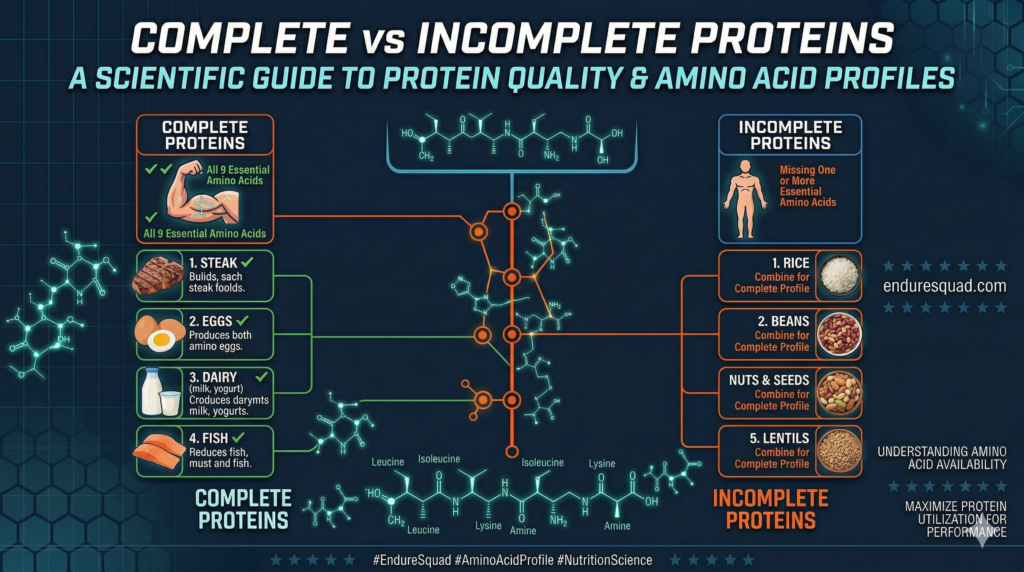
Why Your Body Needs Protein: The 7 Non-Negotiables
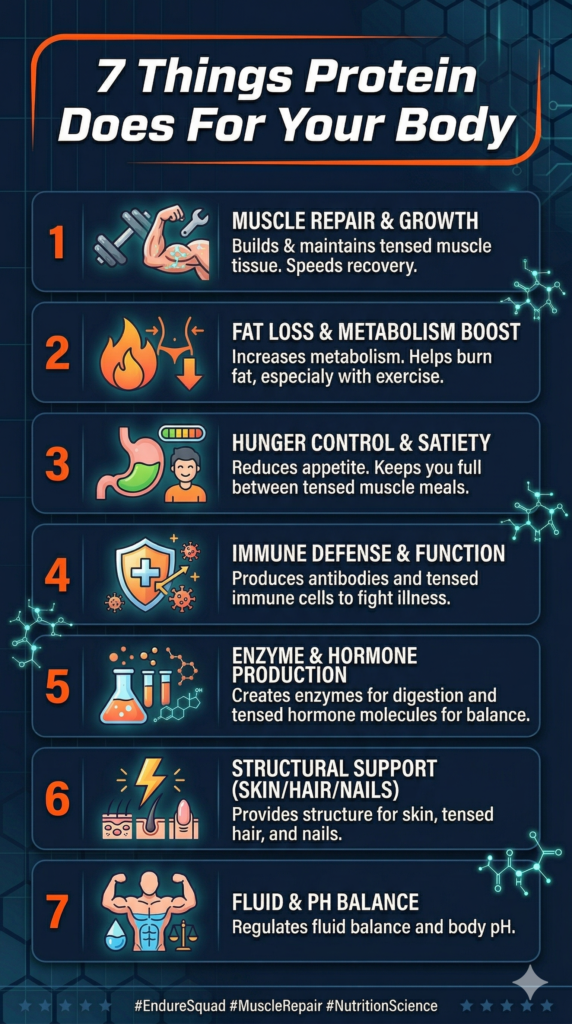
1. Builds and Repairs Muscle
Every time you lift weights, run, or even walk up stairs, you create micro-tears in your muscle fibers. Protein is the material your body uses to repair those tears — and rebuild them thicker and stronger than before.
Think of your muscles like roads. Daily use creates potholes. Protein is the asphalt that fills them in. Skip the protein, and the potholes turn into craters. Keep patching them? You end up with a smoother, stronger road than you started with.
This process is called muscle protein synthesis (MPS) — the holy grail of body composition. Without adequate protein, you can train like an athlete but your body has nothing to rebuild with. It’s like renovating a house but never delivering the materials.
2. Keeps You Full (The Secret Weight Loss Weapon)
Protein is the most satiating macronutrient. It triggers fullness hormones (peptide YY, GLP-1) and suppresses the hunger hormone (ghrelin) better than carbs or fats.
Consider this: eat 500 calories of chicken breast versus 500 calories of pasta. You’ll be hungry again 90 minutes after the pasta. The chicken? 4–5 hours of satisfaction.
Studies consistently show people eating high-protein diets consume 400–500 fewer calories per day — without trying, without counting, without suffering through hunger. Protein turns off the hunger signal naturally.
3. Burns More Calories Through Digestion
Here’s something most people don’t know: digesting protein burns more calories than digesting any other macronutrient. This is called the thermic effect of food (TEF).
- Protein: 20–30% of calories burned during digestion
- Carbohydrates: 5–10%
- Fats: 0–3%
Eat 100 calories of protein, and your body uses 25–30 of those calories just to process it. That’s a free calorie burn built into every meal.
4. Preserves Muscle During Fat Loss
When you eat in a calorie deficit, your body needs fuel. If protein intake is low, it looks for the easiest source — and that’s your muscle. Your body can’t tell the difference between “I’m dieting” and “there’s a famine.” So it does what kept our ancestors alive: it burns the most metabolically expensive tissue first. That’s muscle.
Lose muscle, and your metabolism drops. You burn fewer calories. Fat loss stalls. You end up looking skinny-fat instead of lean and athletic.
The solution: high protein intake during a deficit signals to your body that you still need those muscles. Studies show people eating 1.6–2.4g of protein per kg of body weight during a calorie deficit lose mostly fat while preserving muscle. Drop to 0.8g per kg, and they lose equal amounts of muscle and fat — same calorie deficit, dramatically different results.
Think of your body like a company during a recession. Low protein = layoffs hit your best employees (muscle). High protein = you only cut the dead weight (fat).
5. Supports Immune Function
Antibodies are made of protein. So are the enzymes that destroy viruses and bacteria. Every time your immune system fights an infection, it deploys protein-based weapons.
When protein intake drops too low, your immune system starts rationing resources. Antibody production slows. Recovery from illness takes longer. You become more vulnerable to infections that a well-nourished body would neutralise quickly.
6. Produces Enzymes and Hormones
Virtually every metabolic reaction in your body is driven by an enzyme — and enzymes are made from protein. Digestive enzymes, energy-producing enzymes, DNA repair enzymes. All protein.
Your hormones are no different:
- Insulin (controls blood sugar) — protein-based
- Growth hormone (builds muscle, burns fat) — protein-based
- Thyroid hormones (controls metabolism) — amino acid-based
- Neurotransmitters (serotonin, dopamine) — built from amino acids
Cut protein too low for too long, and your entire hormonal system goes haywire. Metabolism slows. Mood crashes. Energy disappears. Sex drive vanishes.
7. Maintains Healthy Skin, Hair, and Nails
Collagen — the protein that keeps your skin firm and youthful — is 30% of your body’s total protein. Keratin — the structural protein in your hair and nails — is pure protein.
Look at anyone who has crash-dieted for months. Their hair is thin, brittle, and falling out. Their nails are destroyed. Their skin is saggy despite being young. Adequate protein keeps you looking younger, longer.
How Much Protein Do You Actually Need?
The official recommendation of 0.8g per kg of body weight is the bare minimum to prevent deficiency diseases — not the optimal amount for performance, body composition, or longevity. It’s like saying the minimum wage is enough to live on. Technically true, but far from optimal.
The Real Protein Requirements (Based on Science)
If you’re sedentary (desk job, no exercise):
- 0.8–1.2g per kg body weight
- Example: 70kg person = 56–84g protein daily
- Just enough to maintain basic functions
If you’re active (gym 3–5x per week, recreational sports):
- 1.6–2.2g per kg body weight
- Example: 70kg person = 112–154g protein daily
- Supports muscle maintenance and recovery
If you’re an athlete or actively building muscle:
- 2.0–2.4g per kg body weight
- Example: 70kg person = 140–168g protein daily
- Maximises muscle protein synthesis and recovery
If you’re over 60:
- 1.2–1.6g per kg body weight (higher end recommended)
- Older adults have reduced muscle protein synthesis efficiency — they need more protein to get the same anabolic response as younger people
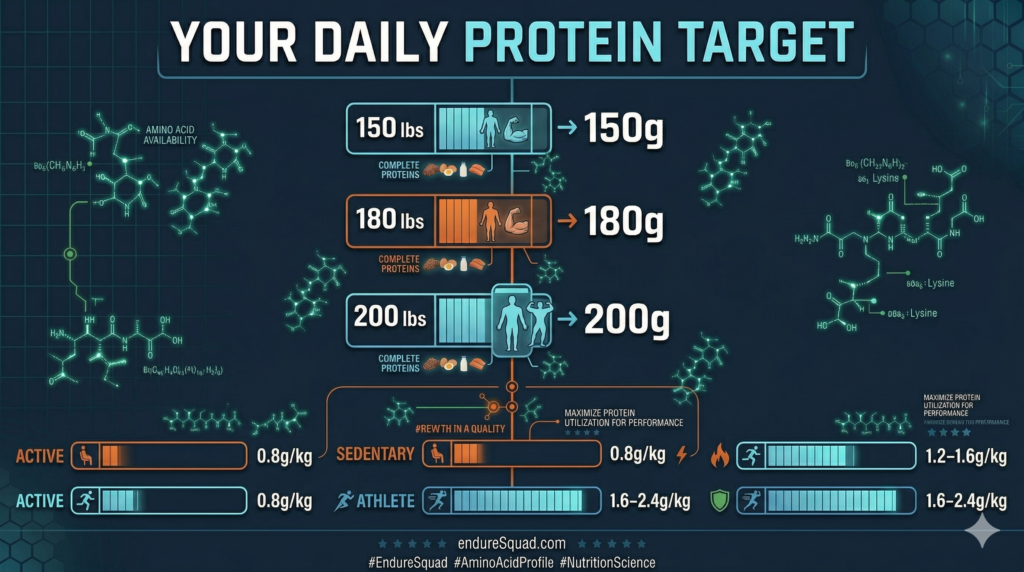
The Simple Rule Most Coaches Use
Just eat 1 gram of protein per pound of body weight:
- Weigh 150 lbs? Eat 150g protein.
- Weigh 180 lbs? Eat 180g protein.
- Weigh 200 lbs? Eat 200g protein.
Is this slightly more than the research-optimal amount for most people? Yes. Is it harmful? No. Is it easier to remember than complicated formulas? Absolutely. And here’s the kicker: most people underestimate their intake anyway, so aiming high ensures you actually hit the target.
The Bottom Line: Protein Is Your Body’s Foundation
So what is protein, in simple terms? It’s the non-negotiable foundation your body is built on. Protein isn’t optional. It’s the raw material for every muscle fiber, every enzyme, every hormone, every immune cell, your skin, hair, and nails, and your mood and energy. Every single day, your body is breaking itself down and rebuilding. Protein determines whether you come back stronger — or weaker.
The question isn’t whether protein matters. The question is: are you eating enough of it?
Part 2 Coming Soon
Now that you understand what protein is and why your body depends on it, the next step is knowing exactly where to get it — and how to time it for maximum results.
Part 2: Best Protein Sources — Complete Guide to Quality, Timing and Myths is coming shortly. In it, you’ll discover the protein quality hierarchy (animal vs plant), the best sources for muscle building and fat loss, whether the post-workout window actually matters, and the most common protein myths fully debunked.
Stay tuned — and in the meantime, start tracking your protein for just 3 days. Most people are shocked by how far below target they are.